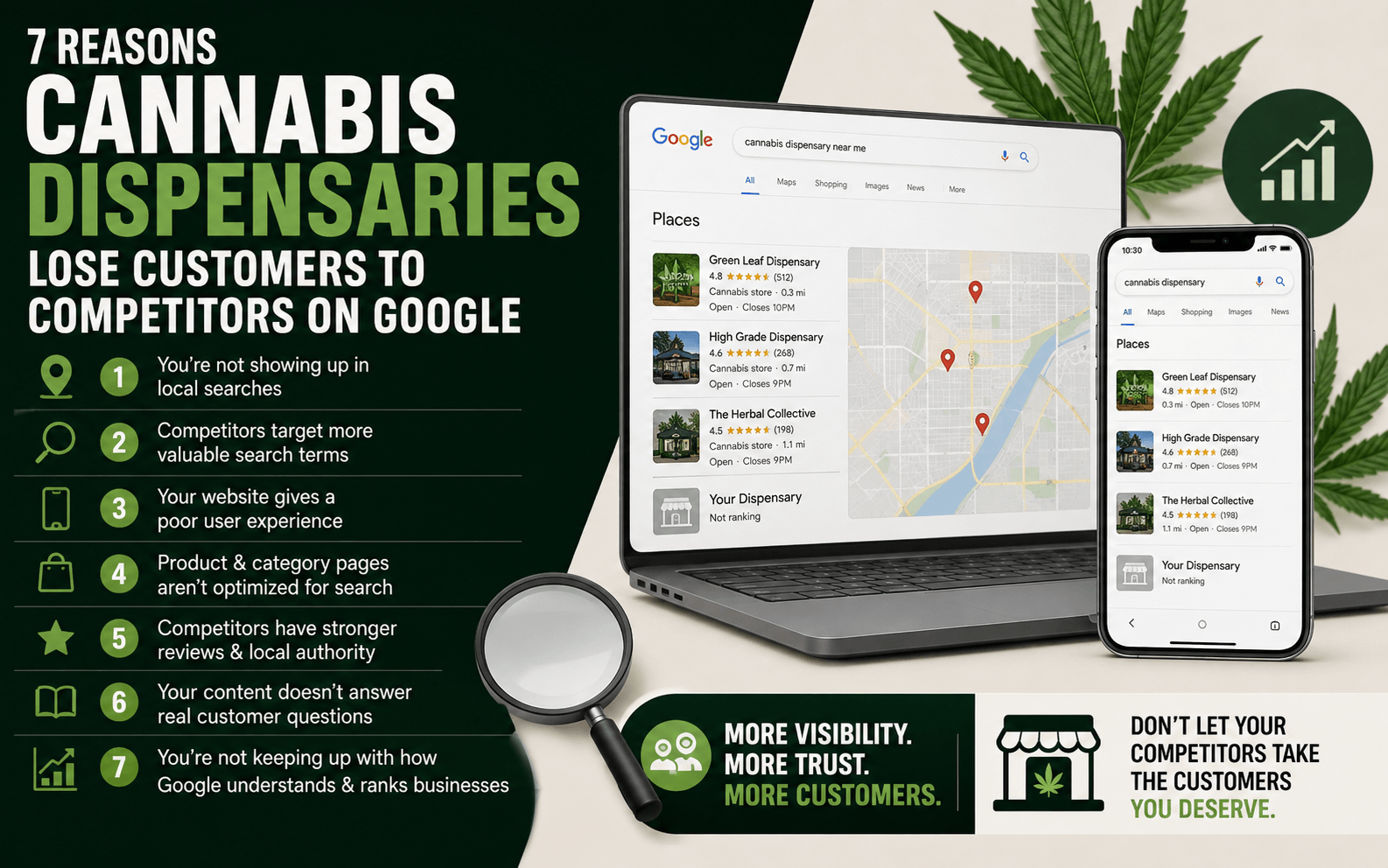
ou search Google for “dispensary near me” and expect to see your business.
Instead, you see three competitors.
You search again from another phone. Different competitors appear.
Then you search your own dispensary name, and your business shows up just fine.
This can be incredibly frustrating.
You have a real dispensary. You have a website. You have products. You may have hundreds of customer reviews and years of experience. Yet when someone nearby searches for a dispensary, Google seems to send them somewhere else.
The important thing to understand is that ranking for your business name is very different from ranking for a non-branded local search such as “dispensary near me.”
When someone searches for your name, Google already has a strong idea of which business they want.
When someone searches “dispensary near me,” Google has to decide which businesses are the best local matches for that particular searcher.
Google says local results are primarily influenced by relevance, distance, and prominence. Relevance is how well the business matches the search, distance considers how far the business is from the searcher, and prominence relates to how well known the business is, with factors such as reviews and links from other websites contributing to that picture.
That is why simply having a Google Business Profile or a website does not guarantee that your dispensary will appear prominently.
If your dispensary is invisible for “dispensary near me” searches, there is usually a reason.
Here are the most common problems to investigate.
First, Understand What “Dispensary Near Me” Actually Means
Before fixing the problem, it helps to understand what Google is trying to do.
A customer searching:
“dispensary near me”
is not giving Google a specific city, neighborhood, or business name.
Instead, Google uses the searcher’s location and other available information to determine which nearby businesses are relevant.
This means two customers standing several miles apart can perform the exact same search and see different local results.
That is normal.
It also means you should be careful when someone tells you:
“Your dispensary ranks #2 for ‘dispensary near me.’”
Where?
From which location?
At what time?
On which device?
Local rankings can vary based on the searcher’s location and the competitive landscape.
So the first question is not:
“Why aren’t I number one everywhere?”
It is:
“Is my dispensary consistently visible in the areas where I actually want customers?”
That is a much more useful question.
1. Your Google Business Profile Is Missing, Unverified, or Not Properly Established
For a physical dispensary, your Google Business Profile is one of the most important pieces of your local search presence.
Google explains that businesses need to add or claim and verify an eligible Business Profile to manage how their business information appears on Google Search and Maps.
If your profile is not properly established, Google may have limited information with which to understand and display your business.
Check the basics first
Make sure:
- Your business has an eligible Google Business Profile
- The profile is claimed
- The profile is verified
- The business name accurately reflects the real-world business
- The address is accurate
- The phone number is correct
- The website points to the correct website
- Opening hours are accurate
- Your primary business category accurately represents the business
- Your business information is consistent with your actual location
Google specifically recommends complete and accurate business information because incomplete or inaccurate information can make it harder for a business to appear for relevant local searches.
Don’t try to manipulate the business name
One common mistake is turning the Business Profile name into something like:
“Best Cannabis Dispensary Toronto Weed Delivery Cheap Cannabis Store”
because the owner wants to rank for more keywords.
That is not how a legitimate local SEO strategy should work.
Your profile should represent the actual business name as it is represented in the real world. Google’s guidelines explicitly require businesses to represent themselves accurately and consistently.
The goal is not to stuff keywords into your profile.
The goal is to give Google accurate business information.
2. Your Dispensary Is Too Far Away From the Searcher
This one surprises many business owners.
You can do almost everything correctly and still not appear for every “near me” search.
Why?
Because distance matters.
Google explains that distance is one of the primary factors used in local results. For searches without a specified location, Google uses information it has about the searcher’s location to estimate distance.
Imagine your dispensary is located in downtown Toronto.
A customer searches:
“dispensary near me”
while they are 10 miles away.
Another dispensary is only one mile from that customer.
Even if your business has:
- More reviews
- A better website
- More products
- Stronger content
the closer business may still be a stronger local result for that particular search.
That does not necessarily mean your SEO is broken.
It means local search is, by definition, location dependent.
This is why local ranking reports can be misleading
If an SEO agency checks your ranking from one location and tells you:
“You rank #4.”
that does not mean every customer sees you at #4.
Another customer may see you at #8.
Someone else may not see you in the top local results at all.
What should you do?
Don’t try to manipulate your location.
Instead, build strong visibility around the geographic market you legitimately serve.
That includes:
- Your actual location
- Relevant nearby neighborhoods
- Your legitimate delivery or service areas where applicable
- Local search intent
- Location-specific website content
- Local authority
- Reviews
- Accurate business information
Distance is something SEO cannot simply “override.”
But relevance and prominence can still be improved.
3. Your Business Profile Isn’t Relevant Enough to the Search
Now we get to the first major factor you can actually influence.
Relevance.
Google describes relevance as how well a Business Profile matches what someone is searching for. It recommends providing complete and detailed business information to help Google understand the business and match it with relevant searches.
This is where many dispensaries have a problem.
The owner knows exactly what the business does.
Google may not have the same level of understanding.
For example, your website may talk extensively about your brand but provide very little useful information about:
- The type of dispensary you operate
- Your physical location
- The customers you serve
- Your products
- Your store experience
- Your legitimate delivery options
- Your local market
Your Business Profile and website should reinforce the same basic business identity.
Think about the searcher’s question
When someone searches:
“dispensary near me”
Google needs to determine:
Which nearby businesses actually match this search?
The clearer your legitimate business information is, the easier it is for Google to understand your relevance.
But don’t overdo it
Local SEO is not about adding the word “dispensary” 50 times to your website.
Keyword stuffing can make content worse for users and does not create genuine local relevance.
Instead, build useful pages that naturally explain:
- Who you are
- Where you are
- What you offer
- Which areas you serve
- How customers can visit or interact with your business
4. Your Dispensary Has a Storefront Problem
This is particularly important for cannabis businesses.
If you operate a cannabis business that delivers, you might assume you can simply create a Google service-area listing and target every city you deliver to.
That is not necessarily allowed.
Google’s Business Profile guidelines specifically state that businesses associated with products or services requiring customers to be a certain minimum age, including cannabis, are not permitted to operate as service-area businesses without a storefront.
This matters.
If your cannabis business is delivery focused but does not have an eligible storefront, you should not simply create a fake location or pretend to operate from an address you do not actually use.
Never use a virtual address just to rank
Google’s guidelines require businesses to represent a real-world location accurately.
Virtual offices and mailing addresses that do not represent an actual operating location are not eligible under Google’s location guidelines.
So if someone tells you:
“We’ll create Google Maps listings in 10 different cities so you can rank for ‘dispensary near me’ everywhere.”
Be careful.
Creating fake locations can create much bigger problems than simply not ranking.
The right approach
If you have a legitimate storefront:
- Use the real location
- Verify the business correctly
- Keep the address accurate
- Use appropriate business information
- Build local authority around that location
If your business model has specific eligibility or regulatory limitations, those need to be considered before implementing a local SEO strategy.
Good cannabis SEO should be compliant as well as effective.
5. Your Competitors Have Stronger Local Prominence
Let’s say your Business Profile is verified.
Your location is legitimate.
Your address is correct.
Your website is good.
Why are competitors still appearing above you?
The answer may be prominence.
Google says prominence reflects how well known a business is and notes that information such as links from other websites and the number of reviews can contribute to local ranking. More reviews and positive ratings can help a business’s local ranking.
This is where the difference between two dispensaries can become significant.
Dispensary A
- 1,000 genuine reviews
- Strong average rating
- Years of local presence
- Mentions from local websites
- Relevant industry links
- Strong organic visibility
- Well-established website
Dispensary B
- 35 reviews
- Few external mentions
- New website
- Limited local authority
- Little organic visibility
Both may be legitimate dispensaries.
But Google has considerably more information suggesting that Dispensary A is an established local business.
This doesn’t mean “get more backlinks at any cost”
Random backlinks are not the answer.
You want relevant authority.
For a dispensary, that might include legitimate mentions from:
- Local publications
- Cannabis industry websites
- Local business organizations
- Community resources
- Relevant directories
- Industry partners
- News coverage
- Other credible websites
The goal is to build a stronger online representation of the business.
6. Your Review Profile Is Weaker Than Your Competitors
Reviews are another part of the local search picture.
But there is an important distinction:
You need genuine customer reviews, not manufactured reviews.
Google explicitly prohibits fake engagement and content that does not represent a genuine customer experience. It also prohibits businesses from manipulating ratings through fake or incentivized activity.
So don’t buy 500 reviews.
Don’t create fake Google accounts.
Don’t offer customers money in exchange for positive reviews.
Don’t ask employees to pretend to be customers.
Those shortcuts can damage the profile you are trying to build.
Instead, build a legitimate review process
After a genuine customer interaction, make it easy for satisfied customers to leave honest feedback.
Then:
- Respond professionally
- Thank customers
- Address legitimate complaints
- Monitor recurring issues
- Improve the business based on feedback
Reviews also affect the customer’s decision.
Imagine someone searches:
“dispensary near me”
and sees:
4.8 stars — 900 reviews
next to:
4.1 stars — 38 reviews
Even before visiting either website, the first business may appear more established.
That is why reputation and SEO often overlap.
7. Your Website Doesn’t Support Your Local Search Presence
A common misconception is:
“Google Maps is separate from my website, so my website doesn’t matter.”
That’s not a good way to think about local SEO.
Google uses information from multiple sources to understand businesses. Google states that Business Profile information can be compiled from publicly available information, including crawled web content from the business’s official website, third-party data, user contributions, and information from Google’s own interactions with a local business.
Your website therefore plays an important supporting role.
Your website should clearly establish your business
Important information should be easy to find.
For example:
- Business name
- Physical location
- Contact information
- Store hours
- About the business
- Products or categories
- Relevant local information
- Legitimate services
- Directions or location information
- Helpful customer resources
You should also have a clear local landing page for your primary location when appropriate.
Avoid generic city pages
Do not create:
Dispensary Toronto
Dispensary Vancouver
Dispensary Montreal
Dispensary Calgary
with almost exactly the same paragraph and only the city name changed.
That is not genuine local relevance.
A useful local page should actually help someone understand the business and the location.
Include information that is genuinely specific to the location, such as:
- Where the store is located
- Nearby areas
- How customers can reach the store
- Relevant store information
- Products or services available
- Local customer questions
- Legitimate service information
The page should exist because it is useful to customers, not simply because an SEO tool says the city has search volume.
8. Your Important Pages May Not Be Indexed Properly
Sometimes the problem isn’t local SEO at all.
It is technical SEO.
You may have created a great location page, category page, or product page.
But if Google cannot properly crawl or index it, the page cannot contribute as expected to organic search visibility.
Google explains that Search works through three broad stages:
Crawling → Indexing → Serving
Google first discovers and crawls pages, then analyzes and stores information from those pages in its index, and finally determines what information to serve for a search. Google also makes clear that it does not guarantee that every page will be crawled, indexed, or served.
Common technical problems include:
- Noindex tags
- Incorrect canonical tags
- Robots.txt blocking
- Broken internal links
- Poor URL structure
- Duplicate pages
- Server errors
- Orphan pages
- Weak internal linking
- JavaScript rendering problems
- Pages returning the wrong status code
Google also explains that JavaScript-heavy websites can create search visibility issues when important content is not available properly during crawling and rendering.
This can matter for dispensaries because many cannabis websites use third-party menus or heavily dynamic product systems.
The customer may see the products.
Google may not see the information in the same way.
Don’t assume Google sees what you see
This is why technical SEO testing matters.
Use tools such as Google Search Console’s URL Inspection and appropriate testing tools to check whether important pages can actually be crawled and rendered as expected. Google specifically recommends URL Inspection and the Rich Results Test when investigating JavaScript-related search problems.
9. Your Product Menu Is Trapped Behind a Third-Party System
This deserves special attention for dispensaries.
A lot of cannabis businesses use external menu systems.
There is nothing automatically wrong with using a third-party platform.
The problem occurs when your entire organic strategy depends on content that Google cannot properly discover, crawl, or associate with your own website.
For example, your customer might see:
Flower
Pre Rolls
Edibles
Concentrates
Vapes
inside an embedded menu.
But your website itself may have very little unique, crawlable content around those categories.
That can make it difficult to build organic visibility around product-related searches.
Your SEO strategy should not depend entirely on a menu widget
Your website should have a meaningful information architecture.
For example:
Cannabis Products
→ Flower
→ Pre Rolls
→ Edibles
→ Concentrates
→ Other relevant categories
Each important page should serve a real purpose.
Google’s technical documentation explains that content generated or exposed through JavaScript can sometimes create crawling and rendering challenges, and recommends testing how Google accesses and renders important content.
This does not mean every third-party menu is bad.
It means you need to know what Google can actually access.
10. Your Competitors Have Better Local Content
Your homepage may say:
“Welcome to our premium cannabis dispensary.”
That’s fine.
But it does not necessarily answer the questions a local customer has.
A stronger local website can explain:
- Where the dispensary is located
- Which neighborhood it serves
- What products are available
- How customers can visit
- What makes the store different
- What customers should know before visiting
- Common product questions
- Local purchasing information
- Store policies
This creates a much clearer connection between the business and its local market.
Don’t write content for Google alone
Write it for the person who is actually searching.
If someone searches:
“dispensary near me”
they probably don’t want a 2,000-word history of cannabis.
They want to know:
Where is it?
Is it open?
What does it offer?
Can I visit?
Can I trust it?
How do I get there?
Your website should help answer those questions quickly.
11. Your Business Information Is Inconsistent Across the Web
Google doesn’t rely only on the information you enter into your Business Profile.
Google says business information can come from multiple sources across the web.
That means inconsistent information can create confusion.
Imagine your website says:
123 Main Street
but an important directory says:
125 Main Street
Another website lists an old phone number.
Another directory has an old business name.
Your opening hours are different in three places.
Customers can become confused.
Search engines also have to reconcile those signals.
Audit your business information
Check important business references for:
- Business name
- Address
- Phone number
- Website
- Hours
- Location details
Correct outdated information where possible.
The goal is simple:
Make your business easy to identify consistently across the web.
12. You Have Multiple Google Profiles for the Same Location
This is another problem that can happen when businesses try to dominate local search.
An owner thinks:
“If one listing doesn’t rank, let’s create three more.”
That’s not the solution.
Google’s guidelines say there should only be one Business Profile per business, with specific exceptions for certain organizational structures.
Creating duplicate profiles for the same physical location can create confusion and potentially cause profile problems.
If you have legitimate multiple locations, each location should be represented according to Google’s guidelines.
If you have one location, don’t manufacture additional locations simply to target different neighborhoods.
Why “Dispensary Near Me” Visibility Matters So Much
There is a major difference between someone searching:
“What is cannabis?”
and someone searching:
“dispensary near me.”
The second person has strong local intent.
They are telling Google:
I want a nearby business.
They may be ready to:
- Visit a store
- Check products
- Compare dispensaries
- Call the business
- Get directions
- Place an order where permitted
- Learn about the store
If your competitor appears and you don’t, your competitor gets the opportunity.
This is why local visibility is not just an SEO vanity metric.
It can directly affect customer acquisition.
Why Your Dispensary Might Show for Your Name but Not “Dispensary Near Me”
This is one of the most common questions owners ask.
You search:
“ABC Cannabis”
Your business appears.
You search:
“dispensary near me”
Your business doesn’t.
That does not necessarily mean Google has removed your website.
These are completely different search situations.
Branded search
Google knows the customer is looking for your business.
Non-branded local search
Google has to decide which businesses best match the searcher’s intent and location.
The second search is much more competitive.
Your competitors may have stronger local relevance, proximity, prominence, reviews, or website signals.
So don’t judge your local SEO only by searching your business name.
Test the searches that new customers use.
How to Check Whether Your Dispensary Really Has a “Near Me” Problem
Don’t simply type “dispensary near me” into Google once and decide your SEO is broken.
Run a proper test.
Step 1: Test from multiple locations
Search from different parts of the city or market you care about.
Local results can change based on the searcher’s location.
Step 2: Check Google Maps
Don’t look only at traditional organic results.
Look at the local business results and Maps.
Step 3: Test related searches
Search variations such as:
- dispensary near me
- cannabis dispensary near me
- cannabis store near me
- dispensary in [city]
- dispensary in [neighborhood]
- cannabis store [city]
- weed delivery [city]
Only target and publish content for terms that are relevant and permitted for your business and market.
Step 4: Compare your competitors
Record:
- Which businesses appear
- Their review counts
- Their ratings
- Their distance
- Their website
- Their categories
- Their local content
- Their authority
- Their overall visibility
Step 5: Check your Business Profile
Confirm:
- Verification
- Business information
- Category
- Address
- Hours
- Website
- Photos
- Reviews
- Profile status
Step 6: Check your website
Make sure your primary location and important commercial pages are:
- Crawlable
- Indexable
- Internally linked
- Useful
- Mobile friendly
- Fast enough
- Relevant to local search intent
What You Should NOT Do to Rank for “Dispensary Near Me”
When business owners become frustrated, they sometimes look for shortcuts.
Avoid them.
Don’t create fake locations
A fake address can create serious Business Profile problems.
Google requires businesses to represent real-world locations accurately and does not allow virtual offices that do not operate as actual business locations.
Don’t stuff keywords into your business name
Your profile name should reflect the real business name.
Don’t buy fake reviews
Google prohibits fake engagement and review manipulation.
Don’t create dozens of duplicate profiles
One legitimate location should not become five fake Google listings.
Don’t create hundreds of doorway location pages
A page for every neighborhood isn’t automatically a local SEO strategy.
If the pages don’t provide unique value, they can become a liability rather than an asset.
Don’t build random backlinks
More links do not automatically mean better local SEO.
Focus on relevance, quality, and legitimate authority.
A Better Strategy for Ranking Your Dispensary in Local Search
There isn’t a single button you can press to rank for “dispensary near me.”
A stronger strategy combines several pieces.
1. Establish your legitimate local presence
Make sure your business is eligible, claimed, verified, and accurately represented.
2. Improve local relevance
Make your website and business information clearly explain what your dispensary is and where it operates.
3. Strengthen prominence
Build legitimate reviews, relevant mentions, links, and brand authority.
4. Improve your website
Make sure important pages are accessible, useful, mobile friendly, and technically sound.
5. Build location-focused content
Create genuinely useful local pages instead of mass-producing thin city pages.
6. Improve product visibility
Make important product categories and commercial pages accessible to search engines rather than relying entirely on third-party menu systems.
7. Monitor competitors
If another dispensary consistently outranks you, find out what they are doing differently.
8. Measure local visibility
Track your performance across the locations and search terms that actually matter to your business.
The Business Impact of Not Showing Up
Let’s say 500 people in your local market search for dispensaries over a period of time.
You don’t know exactly how many of those searches will convert.
But you do know something important:
If customers cannot find you, they cannot choose you.
When your competitor appears in the local results and your business doesn’t, the competitor gets the first opportunity.
That can mean:
Lower visibility
→ fewer website visits
→ fewer calls
→ fewer direction requests
→ fewer store visits
→ fewer orders
→ fewer new customers
This is why local SEO should not be viewed simply as:
“We need better rankings.”
The real goal is:
“We need to be visible when customers in our market are looking for a dispensary.”
That is a much more meaningful business objective.
A Simple “Dispensary Near Me” SEO Checklist
Use this checklist when diagnosing your local visibility.
Google Business Profile
- Business Profile is claimed and verified
- Business is eligible for a Business Profile
- Business name is accurate
- Address is legitimate and accurate
- Primary category accurately represents the business
- Hours are current
- Phone number is correct
- Website is correct
- Profile has useful, authentic photos
- Reviews are genuine and actively managed
Local SEO
- Website clearly identifies the business location
- Local landing page is useful and unique
- Important local information is easy to find
- Business information is consistent across important sources
- Relevant local authority is being built
- Competitor local visibility has been analyzed
Website
- Important pages can be crawled
- Important pages can be indexed
- No accidental noindex tags
- Internal linking is strong
- Location pages are useful
- Product categories are accessible
- Website works well on mobile
- Important content is not hidden behind technical issues
- Page speed and usability have been reviewed
Reputation
- Customers can easily leave genuine feedback
- Reviews are monitored
- Negative feedback is handled professionally
- No fake or purchased reviews
- Local and industry mentions are being developed
When Should You Get a Professional Local SEO Audit?
If you’ve already checked your Business Profile and basic information but your dispensary still doesn’t appear for important local searches, it may be time to look deeper.
A professional audit should answer questions such as:
Is the Business Profile eligible and properly configured?
Are competitors stronger locally?
Is distance the primary limitation?
Does Google understand the business correctly?
Are important pages indexed?
Is the website supporting local relevance?
Are product and category pages technically accessible?
Are reviews and authority significantly weaker than competitors?
Are there duplicate or conflicting business listings?
Are there technical issues preventing Google from understanding important pages?
The objective isn’t to make random changes.
It is to identify the actual reason your business is not visible.
Final Thoughts: “Near Me” Rankings Are About More Than Keywords
If your dispensary isn’t showing up for “dispensary near me,” don’t immediately assume you need more blog posts or more keywords.
Local search is more complicated than that.
Google considers factors including relevance, distance, and prominence, and your local visibility is influenced by the overall information Google has about your business.
Your problem could be:
- An unverified Business Profile
- Inaccurate business information
- A location eligibility issue
- Weak local relevance
- Distance from the searcher
- Fewer reviews
- Lower local prominence
- Weak website signals
- Poor local content
- Technical SEO problems
- Indexing problems
- Product menu limitations
- Duplicate profiles
- Stronger competitors
And sometimes there isn’t a single problem.
There may be several.
The good news is that once you know which part of your local search presence is holding you back, you can build a strategy around fixing it.
Your dispensary does not need to rank first for every search in every location.
It needs to become significantly more visible for the searches and locations that matter to your business.
Is Your Dispensary Invisible for “Dispensary Near Me” Searches?
If customers are finding your competitors instead of your dispensary, Dispensary SEO Company can help identify where your local visibility is breaking down.
Our approach focuses on the areas that actually affect dispensary search visibility, including local SEO, Google Maps optimization, competitor analysis, technical SEO, location pages, keyword research, on-page optimization, authority building, and conversion-focused SEO.
Instead of guessing why your competitors are ranking above you, start with an audit that looks at your actual business, your actual market, and your actual competitors.
Find the local SEO gaps. Fix the visibility problems. Get your dispensary in front of customers searching nearby.
Frequently Asked Questions
Why doesn’t my dispensary show up when I search “dispensary near me”?
The most common reasons include weak local relevance, distance from the searcher, limited prominence, incomplete Business Profile information, weak reviews, technical website problems, or stronger competitors.
Google says local results are primarily influenced by relevance, distance, and prominence.
Why does my dispensary appear when I search its name but not “dispensary near me”?
A branded search tells Google exactly which business the customer wants. A non-branded search such as “dispensary near me” requires Google to choose among competing local businesses based on the searcher’s location and other local signals.
Does Google guarantee that my dispensary will appear for “dispensary near me”?
No.
Google does not guarantee specific local rankings. Local results depend on multiple factors, including relevance, distance, and prominence.
Does having more reviews guarantee better local rankings?
No.
Reviews are one part of local prominence, but they are not the only factor. Google also considers relevance, distance, and other information about the business.
Can I create Google Business Profiles in every city where I deliver?
Not simply because you deliver there.
Google’s guidelines specifically state that cannabis businesses are not permitted to operate as service-area businesses without a storefront. Businesses also need to represent legitimate physical locations accurately.
Always verify the current eligibility and policy requirements for your specific business and market before creating or modifying profiles.
Should I add keywords like “best dispensary” to my Google Business Profile name?
No.
Your Business Profile name should accurately represent the real-world business name. Keyword stuffing the business name is not a legitimate local SEO strategy.
Can my website affect my Google Maps visibility?
Your website is part of the broader information Google can use to understand your business. Google says information in local search can come from publicly available web content, including a business’s official website.
A strong local website can therefore support the overall search presence of the business.
What if my website has a third-party cannabis menu?
A third-party menu isn’t automatically a problem.
The important question is whether important information is accessible to search engines and whether your own website has useful, indexable pages around your products and categories.
Google notes that JavaScript-powered content can sometimes create crawling and rendering issues, so important content should be tested to ensure Google can access and understand it.
How long does it take to rank for “dispensary near me”?
There is no guaranteed timeframe.
Local visibility depends on your market, competition, location, existing authority, Business Profile status, website quality, technical health, reviews, and many other factors.
The first step should be identifying the reason you are currently not visible rather than promising a specific ranking date.
What should I do first if my dispensary isn’t showing?
Start with four things:
1. Check your Business Profile status and eligibility.
2. Verify that your real-world business information is accurate.
3. Compare your local visibility against the dispensaries ranking above you.
4. Audit your website for local relevance, indexing, technical issues, and important commercial pages.
Once those areas are understood, you can prioritize the fixes that are most likely to improve your local search presence.