Marketing a cannabis business online is difficult for a reason that most traditional businesses don’t have to deal with: you can’t always use the same advertising channels as everyone else.
A restaurant can launch a Google Ads campaign, run Facebook promotions, boost Instagram posts, and retarget website visitors.
A cannabis business has to think much more carefully.
Advertising policies vary by platform, product, location, and business model. Google, for example, currently has a limited cannabis advertising pilot in Canada for certain eligible businesses and products, running through the end of 2026. That does not mean every cannabis business can simply start running Google Ads. Eligibility and policy requirements still apply.
That is why cannabis marketing needs to be built around visibility, trust, organic discovery, customer retention, and compliant channels, rather than depending entirely on paid advertising.
The good news is that there are still plenty of ways to grow.
Here are seven practical tips for effectively marketing your cannabis business online.
1. Make Your Cannabis Business Easy to Find on Google
One of the biggest marketing mistakes cannabis businesses make is focusing too much on social media while neglecting search.
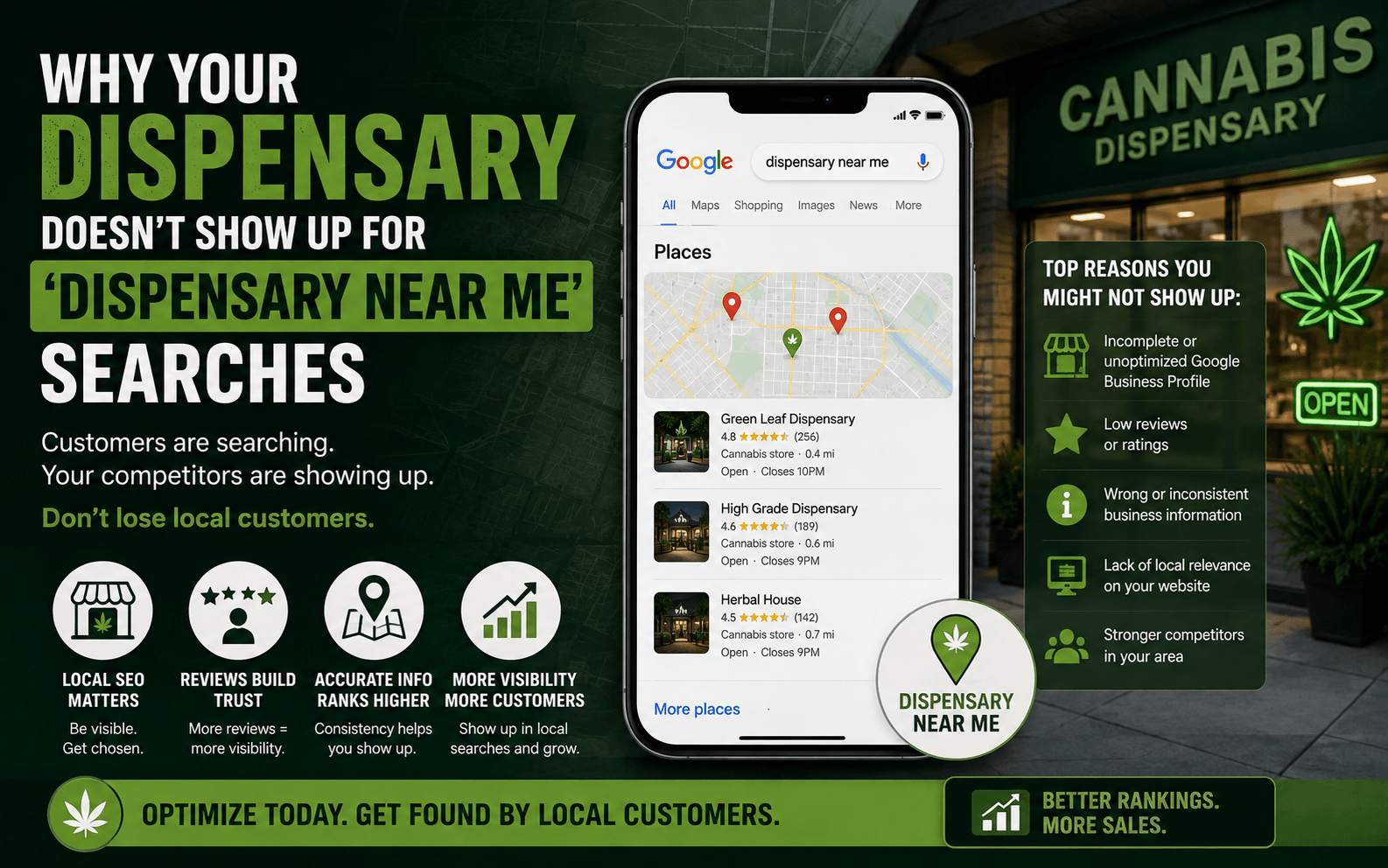
Think about what happens when someone needs a dispensary.
They may search:
“dispensary near me”
Or:
“cannabis dispensary in Toronto”
Or:
“weed delivery near me”
Or:
“best cannabis dispensary in Vancouver”
These searches are valuable because the person is already looking for a business.
You don’t have to convince them that cannabis exists.
You need to make sure your business is visible when they are searching.
This is where SEO becomes one of the most important long-term marketing channels for cannabis businesses.
The original Weedmaps guide also identified SEO as one of the most effective ways cannabis companies can reach customers online, particularly because traditional advertising options have historically been limited.
Start with the basics
Your website should clearly communicate:
- What your business does
- Where you operate
- What products or services you offer
- Who you serve
- How customers can contact you
- Where your physical location is, if applicable
For a local dispensary, your Google Business Profile is also extremely important.
Make sure your:
- Business name
- Address
- Phone number
- Hours
- Website
- Business category
- Location information
are accurate and consistent.
Then build around search intent
Don’t optimize your entire website for one keyword such as “cannabis dispensary.”
Create pages around the searches your customers actually make.
For example:
Cannabis Dispensary in Toronto
Cannabis Delivery in Toronto
Cannabis Flower
Cannabis Edibles
Cannabis Pre Rolls
Cannabis Concentrates
And useful informational content such as:
How to Choose Cannabis Flower
Cannabis Product Types Explained
What Should You Know Before Visiting a Dispensary?
The objective isn’t to create hundreds of pages.
It is to create useful pages that match real customer searches.
2. Create Content That Answers Real Customer Questions
Cannabis customers have questions.
A lot of them.
And those questions represent marketing opportunities.
A potential customer might search:
- What is the difference between THC and CBD?
- How do cannabis edibles work?
- What should I look for when buying cannabis flower?
- What are the different cannabis product formats?
- How do I read a cannabis product label?
- What should a first-time dispensary customer know?
- How should cannabis products be stored?
- What is the difference between pre rolls and flower?
These aren’t just blog topics.
They’re opportunities to introduce your business to people before they are ready to buy.
Don’t write content just because a keyword has search volume
This is where many cannabis websites go wrong.
They publish article after article:
What Is Cannabis?
What Is THC?
What Is CBD?
What Are Edibles?
But hundreds of websites already cover these basic subjects.
Ask yourself:
What can my business explain better or differently?
Maybe your team receives the same customer question every day.
Write about that.
Maybe customers don’t understand product labels.
Create a practical guide.
Maybe first-time customers are confused about product formats.
Create a comparison guide.
Your employees and customers can actually become your best content research sources.
Make content genuinely useful
Google’s guidance emphasizes creating helpful, reliable, people-first content rather than content produced primarily to manipulate search rankings.
For a cannabis business, that means your content should help someone make a better-informed decision.
It should not simply be a collection of keywords.
3. Build a Strong Local SEO Strategy
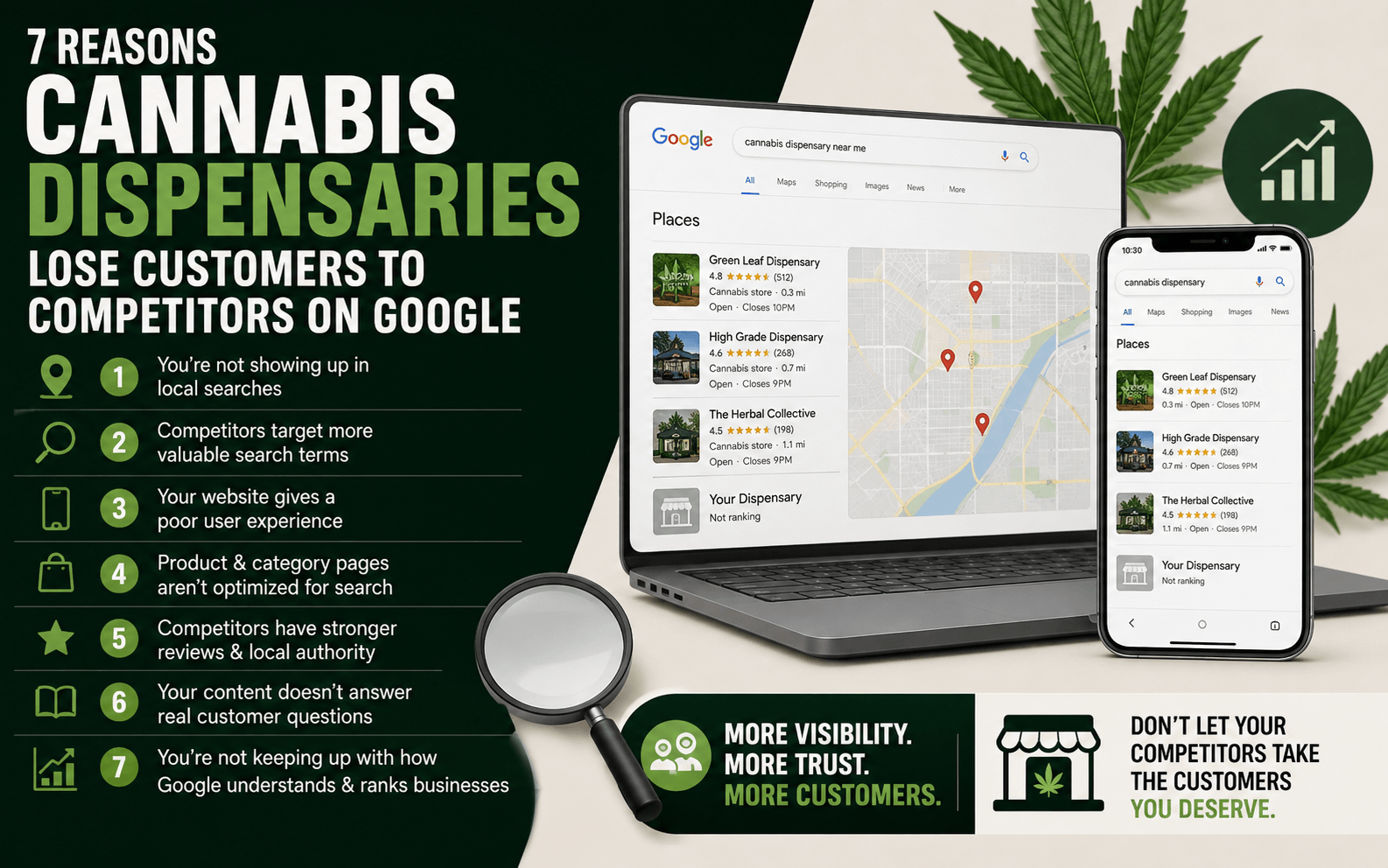
If you operate a physical dispensary local SEO should be one of your highest priorities.
Someone searching:
“dispensary near me”
is much closer to becoming a customer than someone reading a general cannabis article.
Your goal is to become visible when people in your market are actively looking for a dispensary.
Start with Google Maps
Your Google Business Profile should be properly managed and kept current.
Pay attention to:
- Business information
- Category
- Address
- Hours
- Website
- Photos
- Reviews
- Customer questions
- Updates
But don’t stop there.
Your website should support your local presence.
Create a useful location page that explains:
- Where you’re located
- Nearby areas
- How customers can find you
- What your store offers
- Store information
- Relevant customer questions
- Legitimate delivery or service information where applicable

Don’t create fake locations
This is important.
Some businesses try to rank in multiple cities by creating fake addresses or multiple listings.
That is not a sustainable marketing strategy.
If you have one legitimate dispensary location, build authority around that actual location.
If you have multiple legitimate locations, each should be represented accurately.
Reviews matter too
A customer comparing two dispensaries may see:
4.8 stars — 900 reviews
versus:
4.1 stars — 45 reviews
Which business looks more established?
Reviews are not just an SEO consideration.
They influence customer confidence.
Build a legitimate review process and encourage genuine customers to share their experiences where permitted.
4. Use Social Media to Build a Community, Not Just Promote Products
Cannabis businesses often struggle with social media.
You create a post.
It gets little engagement.
You create another.
Then another.
Eventually, the account becomes nothing more than a feed of promotions.
That is a problem.
People don’t follow a business simply because it wants to sell something.
They follow because the content is useful, interesting, entertaining, educational, or relevant to them.
The Weedmaps social media guidance similarly emphasizes keeping business information current, using visual content, engaging with customers, and maintaining consistent activity while staying aware of platform rules.
Think beyond promotional posts
Instead of posting:
“SALE TODAY!”
every day, mix your content.
You could publish:
Educational content
- Product education
- Cannabis terminology
- Responsible-use information
- Industry information
- Legal updates
Brand content
- Behind-the-scenes content
- Team introductions
- Store environment
- Company story
- Community involvement
Customer-focused content
- Frequently asked questions
- Product comparisons
- Shopping tips
- Beginner resources
Community content
- Local events
- Industry news
- Relevant partnerships
- Community initiatives
Your social media should make people feel like they’re following a real business, not a digital billboard.
And always check platform rules
Cannabis-related social media policies can change.
Don’t assume that something another cannabis company is posting is automatically permitted for your account.
Review the current platform rules before publishing promotional or product-related content.
5. Build an Email List You Actually Own
This is one of the most overlooked cannabis marketing strategies.
You don’t control Google.
You don’t control Instagram.
You don’t control Facebook.
You don’t control marketplace algorithms.
But you can build a customer database through legitimate, consent-based email marketing.
The original Weedmaps article also highlighted newsletters as a valuable cannabis marketing channel because they give businesses a direct way to communicate with their existing audience.
Why email is valuable
Imagine someone visits your website today.
They don’t buy anything.
Without a way to stay connected, that person may never come back.
But if they voluntarily subscribe to your email list, you have an opportunity to continue providing useful information.
Depending on your business, audience, local laws, and consent requirements, your emails might include:
- Educational guides
- New store announcements
- Business updates
- New content
- Loyalty communications
- Events
- Permitted promotions
- Seasonal updates
- Customer resources
Don’t send the same email to everyone
Segmentation can make email much more useful.
For example:
New subscriber
might receive a welcome sequence.
Existing customer
might receive educational content and relevant updates.
Repeat customer
might receive loyalty communications.
Customer interested in a particular category
might receive content related to that category.
The more relevant your communication is, the less likely it feels like spam.
And make sure your email marketing complies with applicable privacy and anti-spam requirements in the markets where you operate.
6. Use Cannabis Publications, Partnerships, PR, and Native Advertising
You don’t always have to build an audience from scratch.
There are already cannabis publications, industry websites, local media outlets, communities, events, and businesses with established audiences.
Partnerships can help you reach those audiences.
The original Weedmaps article recommended content and press, native advertising, and partnerships as ways cannabis businesses could expand their digital reach when traditional advertising channels were limited.
The opportunity still exists, but you should approach it more strategically.
Consider opportunities such as:
- Cannabis publications
- Local news websites
- Industry publications
- Cannabis events
- Relevant newsletters
- Local business organizations
- Community partnerships
- Industry podcasts
- Expert interviews
- Educational collaborations
- Native advertising opportunities
PR can be particularly useful
Don’t send a press release every time you change something on your website.
Give journalists a reason to care.
For example:
- Launching a new business
- Opening a new legitimate location
- Supporting a community initiative
- Publishing original research
- Participating in an industry event
- Introducing an interesting business initiative
- Providing expert commentary on an industry issue
The goal is not simply to get a backlink.
The goal is to get your business in front of people who may actually care about it.
Partnerships can create multiple benefits
A good partnership might generate:
Brand exposure
→ Referral traffic
→ New customers
→ Industry credibility
→ Potential editorial mentions
→ Long-term relationships
That is much more valuable than buying random links from unrelated websites.
7. Measure What Actually Produces Customers
This might be the most important tip of all.
Many cannabis businesses are doing marketing without knowing which activities actually produce results.
They see:
10,000 impressions
and assume the campaign worked.
But impressions don’t pay the bills.
You need to connect marketing activity to business outcomes.
Track your SEO
Look at:
- Organic traffic
- Search impressions
- Clicks
- Non-branded searches
- Local visibility
- Important keyword rankings
- Organic conversions
- Calls
- Direction requests
- Leads
- Sales where appropriate and legally measurable
Track your content
Ask:
- Which articles attract visitors?
- Which pages generate engagement?
- Which articles lead people to commercial pages?
- Which topics bring qualified traffic?
You may discover that one highly useful article generates more valuable traffic than ten generic blog posts.
Track email
Monitor:
- Subscriber growth
- Open rates
- Click rates
- Unsubscribe rates
- Conversions where appropriately measurable
Track partnerships
Measure:
- Referral traffic
- Leads
- New customers
- Brand mentions
- Qualified traffic
- Conversions
Track your customer acquisition cost
Ultimately, the question is:
How much does it cost us to acquire a customer, and how valuable is that customer over time?
That is a much better marketing question than:
“How many people saw our post?”
How the 7 Tips Work Together
The real power comes when you stop treating each marketing channel separately.
Imagine your cannabis business publishes a useful article:
“How to Choose Cannabis Flower: A Beginner’s Guide.”
That single resource can become:
SEO
The article can rank for relevant informational searches.
Social Media
You can turn the key points into educational posts.
You can send the article to your opted-in subscribers.
PR
You can use original insights from the article in an industry pitch.
Partnerships
A relevant publication or organization may reference the resource.
Local SEO
If appropriate, you can connect educational content with your local business experience.
Analytics
You can measure whether the content actually generates qualified traffic and customer actions.
One piece of useful content can therefore support several marketing channels.
That’s much more efficient than constantly creating disconnected campaigns.
What Cannabis Business Owners Should Stop Doing
If you’re spending money on marketing but not seeing results, look for these common problems.
Stop relying on one platform
If your entire acquisition strategy depends on Instagram, Google, or another platform, you are vulnerable to policy and algorithm changes.
Stop publishing generic content
More content does not automatically mean more customers.
Stop buying cheap backlinks
A thousand irrelevant links are not a substitute for genuine authority.
Stop creating fake reviews
Build your reputation through real customer experiences.
Stop targeting every city
If you don’t have a legitimate presence in a location, don’t pretend that you do.
Stop measuring vanity metrics
Traffic, impressions, and followers are useful only when they contribute to meaningful business outcomes.
Stop copying competitors
Your competitor’s marketing strategy may not be appropriate for your business, location, product, or audience.
A Practical Cannabis Online Marketing Strategy
If you are starting with a limited budget, don’t try to do everything at once.
Start with the foundation.
Step 1: Fix Your Website
Make sure the website is:
- Fast
- Mobile friendly
- Easy to navigate
- Technically healthy
- Secure
- Easy for search engines to crawl
- Clear about your business and location
Step 2: Build Local Visibility
Optimize your legitimate local presence and make sure your business information is accurate.
Step 3: Research Your Customers
Find out what people actually search for.
Don’t guess.
Use search data, customer questions, competitor research, Search Console data, and real conversations with customers.
Step 4: Create Useful Content
Build content around real customer problems.
Step 5: Build Your Email Audience
Create legitimate ways for interested customers to subscribe and stay connected.
Step 6: Develop Partnerships
Look for relevant publications, businesses, organizations, events, and communities.
Step 7: Measure Everything
Find out which activities produce qualified traffic, leads, customers, and revenue.
Then invest more in what works.
Final Thoughts
Marketing a cannabis business online requires more creativity than marketing many traditional businesses.
You cannot assume every advertising platform will accept your products.
You cannot build your entire strategy around social media.
And you cannot expect customers to find you simply because you built a website.
You need to create visibility intentionally.
That means:
- Improve your Google visibility
- Create genuinely useful content
- Strengthen local SEO
- Build a real social media community
- Grow an owned email audience
- Use partnerships, PR, and compliant advertising opportunities
- Measure the channels that actually produce customers
The cannabis businesses that build these foundations are less dependent on any single platform.
And that’s important in an industry where marketing policies and digital platforms can change quickly.
At Dispensary SEO Company, our focus is helping cannabis businesses build sustainable online visibility through SEO, local SEO, content strategy, technical optimization, competitor research, and other digital marketing strategies designed around the realities of the cannabis industry.
If your business is struggling to generate consistent organic traffic or you’re tired of relying on platforms that restrict cannabis advertising, the first step is to identify where your current online presence is losing potential customers.
Build visibility. Strengthen your search presence. Turn more online searches into real business opportunities.
Frequently Asked Questions
What is the best marketing strategy for a cannabis business?
There is no single strategy that works for every cannabis business. A strong approach usually combines SEO, local SEO, content marketing, social media, email, partnerships, PR, and advertising opportunities that are legally and platform permitted.
Can cannabis businesses advertise on Google?
Advertising eligibility depends on the product, location, and current Google policies. In Canada, Google currently operates a limited cannabis Search pilot through the end of 2026 for specific eligible entities and products.
Businesses should check the current policy before launching campaigns.
Is SEO important for cannabis businesses?
Yes. SEO can be particularly valuable because customers actively use search engines to find dispensaries, cannabis products, educational information, and local businesses.
Should a dispensary focus on local SEO?
Absolutely. If your business operates a legitimate physical location, local search can be one of the most valuable sources of new customers because people frequently search for nearby businesses.
How often should a cannabis business publish blog posts?
There is no magic number.
Focus on quality, relevance, and customer intent rather than publishing content simply to increase your article count.
One excellent resource that answers an important customer question can be more valuable than several generic articles.
Is email marketing worth it for cannabis businesses?
Yes, provided it is conducted with proper customer consent and complies with applicable privacy and anti-spam requirements.
Email gives you a direct relationship with subscribers rather than relying entirely on third-party algorithms.
Can cannabis businesses use social media?
Cannabis businesses can have social media strategies, but individual platforms have their own rules regarding cannabis content, products, promotions, and advertising. Policies can also change, so businesses should review the current rules for each platform.
How long does cannabis SEO take?
SEO is a long-term strategy rather than an instant marketing channel.
The timeline depends on your competition, website authority, technical health, content quality, local market, existing rankings, and how aggressively you implement the strategy.