You may have better products than your competitors. You may offer better prices, faster delivery, a larger menu, or better customer service.
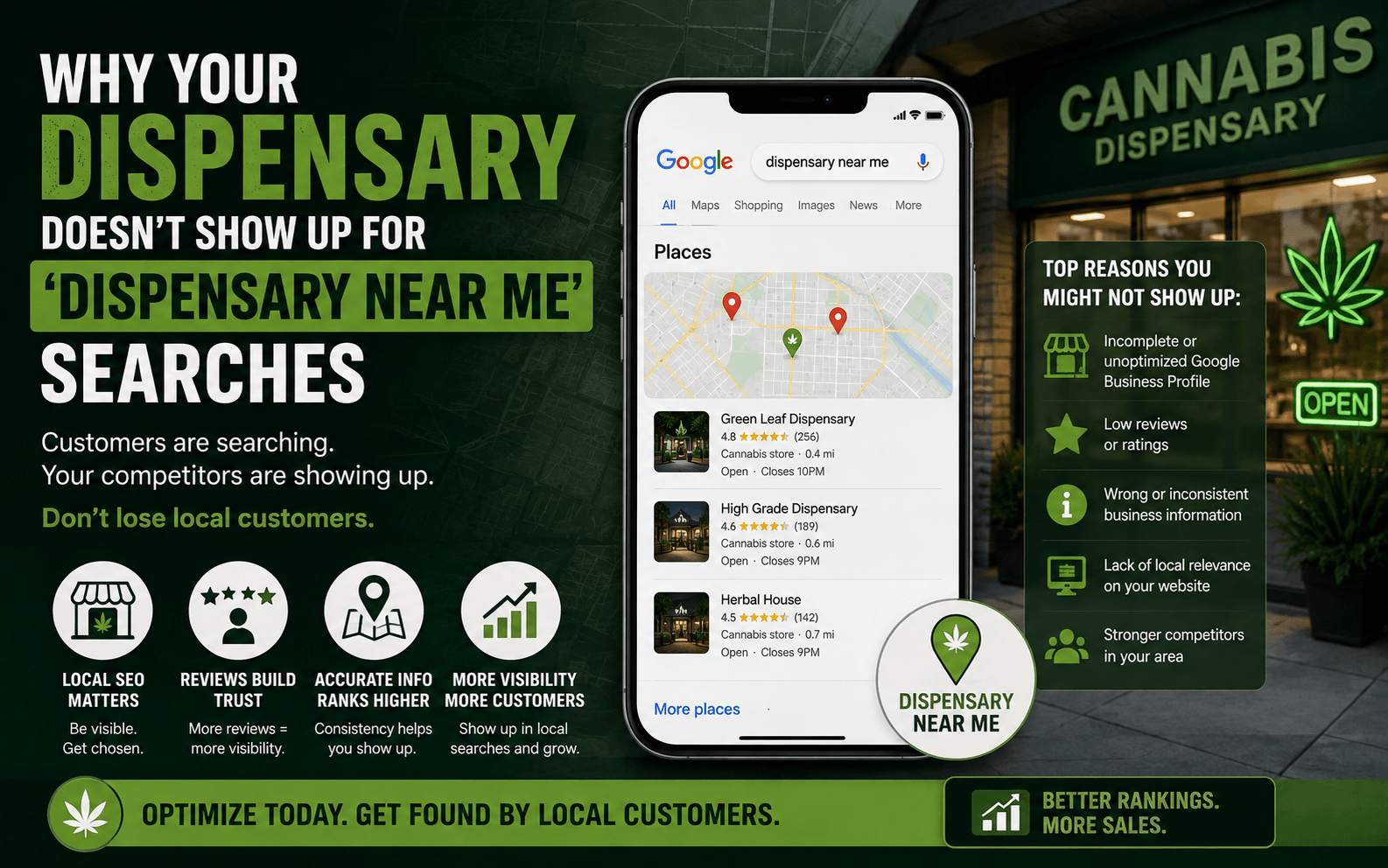
But if customers cannot find your dispensary when they search Google, none of those advantages matter.
This is one of the most frustrating problems for cannabis dispensary owners. You know people are searching for cannabis in your city. You know competitors are getting those customers. You may even see businesses ranking above you that you believe offer a weaker overall experience.
So why are they winning?
In many cases, the answer is not that they have a better dispensary. They have built a stronger presence where customers are looking for one: Google Search and Google Maps.
Google says local search results are primarily influenced by relevance, distance, and prominence. Relevance determines how well a business matches a search, distance considers how close it is to the searcher, and prominence reflects how well known the business is, including signals such as reviews and links from other websites.
For a cannabis dispensary, this means having a website is not enough.
You need a website and local presence that make it easy for potential customers to find you, understand what you offer, trust your business, and take the next step.
Here are seven common reasons cannabis dispensaries lose customers to competitors on Google.
1. Your Dispensary Is Not Visible for the Searches Customers Actually Make
One of the biggest mistakes dispensary owners make is assuming customers search only for their business name.
They don’t.
A customer who has never heard of your dispensary might search:
- cannabis dispensary near me
- dispensary near me
- cannabis store near me
- weed delivery near me
- cannabis delivery in [city]
- dispensary in [neighborhood]
- best dispensary in [city]
- cannabis shop near me
- cannabis flower near me
- cannabis edibles near me
These are valuable searches because they often come from people who are actively looking for a business.
If your dispensary does not appear for those searches, another dispensary gets the click.
The problem is bigger than being number one
You do not necessarily need to rank first for every cannabis keyword.
The bigger problem is having no meaningful visibility at all for searches that matter to your business.
For example, imagine you operate a dispensary in Toronto.
A customer searches:
“cannabis dispensary near me”
Three competitors appear in the local results.
Your business is nowhere to be found.
That customer is unlikely to spend another 20 minutes searching for your company.
They will choose from the businesses they can already see.
You have potentially lost the customer before they ever visited your website.
What dispensary owners should check
Search for your most important terms from the areas you actually serve.
Check:
- Google Maps
- Local Pack results
- Organic results
- Location-specific searches
- “Near me” searches
- Delivery searches
- Product-related searches
Do not only search your business name.
Search like a customer who has never heard of you.
That is where the real competitive picture appears.
2. Your Competitors Are Targeting More Valuable Search Terms
Another reason dispensaries lose customers is that their SEO strategy is based on a small list of generic keywords.
For example, a business may focus almost entirely on:
“cannabis dispensary”
But that is only one part of the potential search market.
Customers search at different stages of the buying journey.
Someone may search:
“what is an indica strain?”
That person is researching.
Another person may search:
“best cannabis flower in Toronto”
That person is comparing options.
Someone searching:
“cannabis dispensary Toronto”
has stronger local commercial intent.
And someone searching:
“cannabis delivery Toronto”
may already be looking for a business that can fulfill an order.
These searches should not all be treated the same.
Build around customer intent
A stronger dispensary SEO strategy considers several types of searches.
Local commercial searches
Examples:
- cannabis dispensary in [city]
- dispensary near [neighborhood]
- cannabis store in [city]
- cannabis shop near me
Delivery searches
Examples:
- cannabis delivery in [city]
- weed delivery near me
- same day cannabis delivery
- cannabis delivery [area]
Product searches
Depending on the products your business legitimately offers:
- cannabis flower
- pre rolls
- cannabis edibles
- cannabis gummies
- cannabis concentrates
- cannabis beverages
Informational searches
Examples:
- how to choose cannabis flower
- what is THC
- what is CBD
- cannabis product types explained
- how cannabis edibles work
The objective is not to create a separate page for every possible keyword variation.
The objective is to make sure your website covers the real topics and search intents that matter to your customers.
Google’s SEO guidance specifically recommends anticipating the terms users may search for while creating helpful, reliable, people-first content.
The business-owner pain point
This is where many dispensary owners say:
“We have hundreds of products. Why aren’t people finding us?”
Because having products does not automatically create search visibility.
Google needs to be able to understand your pages, categories, products, locations, services, and the purpose of the website.
Your competitor may simply have built a better search structure around the demand already existing in your market.
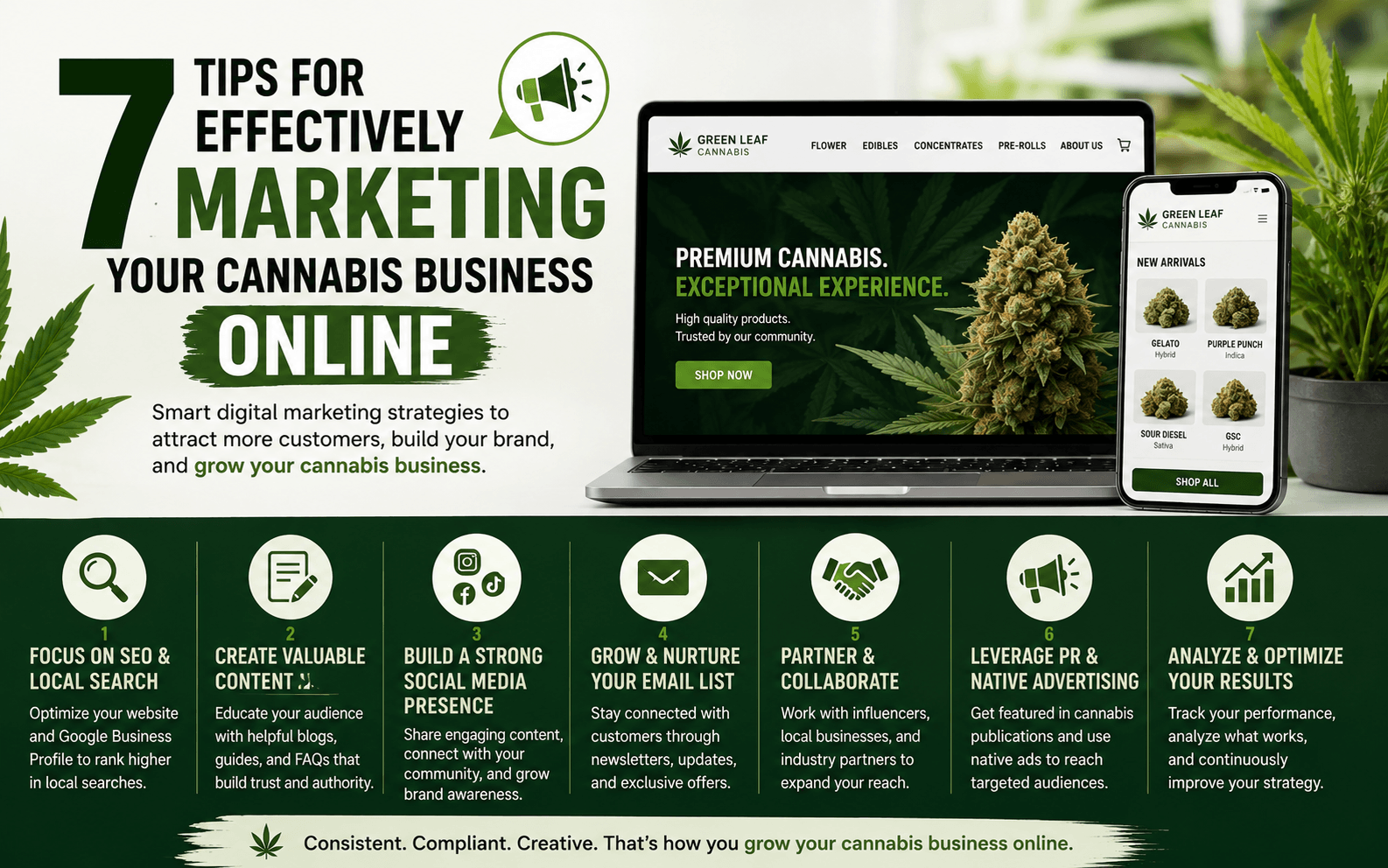
Additional Guide: Cannabis Marketing: A Strategic Guide for Dispensaries
3. Your Website Is Making Customers Work Too Hard
Getting a customer to your website is only half the job.
What happens after they arrive?
This is where many dispensaries lose potential customers.
Imagine someone searches for a dispensary and clicks your website.
They have a simple question:
“Can I get what I want from this business?”
But instead of finding the answer quickly, they encounter:
- A slow website
- Confusing navigation
- Poor mobile design
- Outdated product information
- Difficult menus
- Missing location information
- Unclear delivery details
- Weak calls to action
- Broken links
- Poor product categorization
The customer becomes frustrated.
So they go back to Google.
Then they click your competitor.
Your website should answer basic questions quickly
A potential customer should be able to understand:
Who are you?
Where do you serve?
What do you offer?
How does ordering or visiting work?
Why should they choose you?
What should they do next?
The answer should not be buried underneath several paragraphs of generic marketing copy.
Mobile experience matters
Cannabis searches are highly local and often happen when customers are already looking for a nearby business or delivery option.
That means your mobile experience deserves serious attention.
Test your site from a phone.
Can someone find your location?
Can they access your menu?
Can they understand your delivery area?
Can they find your contact information?
Can they navigate your product categories without frustration?
If the answer is no, you may be losing customers even when your SEO successfully brings them to the website.
SEO and conversion are connected
A ranking is not the final goal.
The real journey is:
Search → Click → Website → Trust → Action → Customer
If the website fails between the click and the action, more traffic will not necessarily solve the problem.
4. Your Product and Category Pages Are Not Doing Enough SEO Work
Many dispensaries have large product menus but surprisingly weak organic visibility.
This often happens because the website contains products without building a strong structure around them.
For example, a dispensary may have hundreds of products but only a handful of useful category pages.
The website might have:
Products
and then immediately list everything.
From a customer’s perspective, that may be acceptable.
From an SEO perspective, it can leave valuable opportunities underdeveloped.
Your category structure should make sense
Depending on your actual inventory and business model, your website might organize products into meaningful categories such as:
- Cannabis Flower
- Pre Rolls
- Edibles
- Concentrates
- Beverages
- Vapes
- Other relevant product categories
Each important category should provide useful information instead of being nothing more than a product grid.
Customers should be able to understand what the category contains and how to navigate it.
Product information needs to be clear
A useful product page should make important information easy to understand.
Depending on the product and applicable regulations, this can include:
- Product name
- Brand
- Product type
- Relevant product attributes
- Available information
- Pricing where appropriate
- Availability where appropriate
- Product description
- Related products or categories
Technical SEO matters here as well.
Google explains that structured data can help it understand ecommerce content, while product structured data can support richer representations of product information in Search when the requirements are met.
That does not mean adding schema will automatically make a dispensary rank.
It means your technical implementation should accurately communicate the information already present on your pages.
Check the technical foundation
A cannabis dispensary SEO audit should examine:
- Indexation
- Crawlability
- Canonical URLs
- XML sitemap
- Internal links
- Product URLs
- Category architecture
- Duplicate pages
- Thin content
- Metadata
- Image optimization
- Mobile usability
- Page speed
- Structured data
- JavaScript-rendered content
The question is simple:
Can Google efficiently discover, crawl, understand, and index the pages that matter to your business?
If not, your competitors may be getting visibility for pages you already have but have not properly optimized.
5. Your Competitors Have More Local Trust
Google does not evaluate a local business based only on the words written on its website.
Local prominence matters too.
Google’s own documentation explains that prominence can be influenced by information such as reviews and links from other websites.
This creates a major competitive difference between dispensaries.
Consider two businesses.
Dispensary A
- Strong website
- Consistent local information
- Hundreds of genuine customer reviews
- Good ratings
- Mentions from relevant websites
- Local authority
- Strong website backlinks
Dispensary B
- Basic website
- Few reviews
- Limited local mentions
- Few relevant links
- Weak online reputation
Even if Dispensary B has excellent products, Dispensary A may have a much stronger search presence.
Reviews matter to customers too
Think about the customer experience.
A customer sees:
4.8 stars — 850 reviews
versus:
4.1 stars — 42 reviews
Which business feels safer to investigate?
The answer is obvious.
Reviews can help establish confidence before a customer even visits your website.
But don’t chase fake reviews
The answer is not buying reviews or manipulating customer feedback.
Build a legitimate review process.
Ask satisfied customers for honest feedback.
Respond professionally.
Monitor recurring complaints.
And use customer feedback to improve the actual business.
Look beyond Google
Your local authority can also be supported by legitimate mentions across the web.
Depending on the market, this might include:
- Local publications
- Relevant industry websites
- Business directories
- Local organizations
- Community websites
- Cannabis industry resources
- Brand partnerships
- News coverage
The objective is not to collect hundreds of random backlinks.
The objective is to build real authority around the business.
6. Your Content Is Generic While Competitors Are Answering Real Customer Questions
This is one of the easiest problems to identify.
Search Google for cannabis topics and you will find countless articles saying essentially the same things.
“Benefits of cannabis.”
“Indica vs. sativa.”
“What is THC?”
“How cannabis works.”
There is nothing inherently wrong with these subjects.
The problem is publishing another generic version that provides no additional value.
Your customers have much better questions
A dispensary has direct access to real customer questions every day.
Your staff probably hear questions such as:
- How do I choose between different cannabis products?
- What should a first-time customer know?
- What is the difference between product formats?
- How should cannabis products be stored?
- How do I understand the information on a product label?
- What should I consider when comparing products?
- What does a particular cannabis term mean?
- How does delivery work in my area?
Those questions can become useful content.
That is much stronger than producing articles simply because a keyword tool says there is search volume.
Use your business knowledge
Your budtenders, customer service team, product specialists, and owners may have information that competitors do not.
Use it.
Create content based on:
- Real customer questions
- Product knowledge
- Local experience
- Frequently misunderstood topics
- Common purchasing questions
- Actual business experience
Google’s current guidance encourages original, substantial, people-first content and specifically asks whether content demonstrates first-hand expertise and provides meaningful value beyond what other pages already offer.
Don’t publish content just to publish content
You don’t need 100 blog posts because another SEO company told you that you need “fresh content.”
You need the right content.
One excellent article that genuinely answers a customer question can be more useful to your business than ten generic articles that nobody needs.
7. You Are Not Measuring the Right SEO Problems
This is perhaps the biggest issue of all.
Many dispensary owners receive an SEO report showing:
Keywords: Up
Traffic: Up
Backlinks: Up
And yet the owner asks:
“Why aren’t I getting more customers?”
That’s a legitimate question.
SEO reporting should connect search visibility with business objectives.
Rankings alone don’t tell the whole story
Suppose you rank #2 for:
“what is cannabis?”
But you do not rank for:
“cannabis dispensary near me”
The first keyword may generate traffic.
The second may generate customers.
Those are very different business outcomes.
Track commercial visibility
Your SEO reporting should examine searches related to:
- Your city
- Your neighborhoods
- Your delivery areas
- Your major product categories
- Your commercial services
- High-intent customer searches
- Branded searches
- Non-branded searches
You should also monitor:
- Organic clicks
- Organic impressions
- Search visibility
- Google Maps visibility
- Website conversions
- Calls
- Direction requests
- Contact actions
- Relevant page performance
- New customers from organic search
The exact metrics will vary by business model, but the principle remains the same:
Measure whether SEO is helping the business, not just whether a keyword moved three positions.
The Real Cost of Losing Customers on Google
Let’s put the problem into business terms.
Imagine 100 potential customers search for dispensaries in your market.
Your competitor consistently appears in front of them.
You don’t.
Those people may never know your business exists.
Now imagine that situation happening every day.
The loss is not simply:
“We lost some rankings.”
It could mean:
Lost visibility → Lost clicks → Lost opportunities → Lost customers → Lost revenue
And this is why dispensary SEO should be treated as a business acquisition channel rather than simply a marketing task.
Your competitor does not have to convince your existing customer to leave you.
They only need to be visible when someone is searching for a dispensary and you are not.
How to Stop Losing Customers to Competitors on Google
The first step is not publishing another blog post.
The first step is finding out where your competitors are beating you.
A proper competitive SEO analysis should examine at least these areas.
1. Local visibility
Compare your Google Maps presence with competing dispensaries.
Look at:
- Local rankings
- Business Profile optimization
- Categories
- Reviews
- Business information
- Website relevance
- Local prominence
2. Keyword gaps
Find the searches competitors rank for that your website does not.
Separate them into:
- Local
- Commercial
- Product
- Delivery
- Informational
Then prioritize the terms that have actual business value.
3. Website gaps
Compare your website with competitors.
Look at:
- Navigation
- Category structure
- Location pages
- Product pages
- Internal linking
- Mobile experience
- Page speed
- Calls to action
4. Content gaps
Identify questions competitors answer that your website doesn’t.
Then create better resources rather than simply rewriting their content.
5. Authority gaps
Compare:
- Relevant backlinks
- Local mentions
- Industry references
- Reviews
- Brand visibility
6. Technical gaps
Check whether important pages are:
- Indexed
- Crawlable
- Internally linked
- Canonicalized correctly
- Mobile friendly
- Technically accessible
7. Conversion gaps
Finally, ask:
If Google sends me the customer tomorrow, am I ready to convert them?
This question is often overlooked.
A Practical Cannabis Dispensary SEO Action Plan
If your dispensary is struggling against competitors, start with these steps.
Step 1: Identify your five strongest local competitors
Don’t choose them because you personally consider them competitors.
Find the businesses consistently appearing when customers search your important terms.
Step 2: Build a keyword gap report
Find searches where competitors appear and your website does not.
Step 3: Audit Google Maps
Check your profile, reviews, categories, business information, photos, website connection, and local relevance.
Step 4: Audit your website
Find technical issues preventing search engines and customers from using the website effectively.
Step 5: Rebuild important pages
Improve your main location, category, service, and product pages around real customer intent.
Step 6: Create useful content
Answer actual customer questions using your business knowledge and experience.
Step 7: Build legitimate authority
Earn relevant mentions, links, reviews, and local recognition rather than buying low-quality links.
Step 8: Measure business outcomes
Track organic traffic alongside meaningful actions and customer acquisition.
The Bottom Line
Your dispensary does not need to be the biggest business in the market to win on Google.
But it does need to be visible, relevant, trustworthy, technically accessible, and useful when customers search.
If competitors consistently appear ahead of you, don’t assume they have a better business.
They may simply have:
- A stronger local presence
- Better keyword targeting
- Better website architecture
- Better product and category pages
- More customer reviews
- Greater local authority
- More useful content
- A better conversion experience
And every customer who chooses them because they found them first is a customer you had an opportunity to win.
The first step is understanding exactly where the gap exists.
Is Your Dispensary Losing Customers to Competitors on Google?
At Dispensary SEO Company, the focus should not be on vanity rankings or publishing content simply to increase traffic.
The goal is to identify why competing dispensaries are getting the visibility and customers your business wants, then build a search strategy around those gaps.
That can include:
- Cannabis dispensary SEO
- Local SEO
- Google Maps optimization
- Cannabis keyword research
- Competitor SEO analysis
- Technical SEO
- Product and category page optimization
- Location page optimization
- Content strategy
- Internal linking
- Authority and link building
- Conversion-focused SEO
If your competitors are consistently appearing above your dispensary for valuable searches, it’s time to find out why.
Find the SEO gaps. Fix the visibility problems. Get your dispensary in front of more customers searching for what you offer.
Frequently Asked Questions
Why is my dispensary not ranking on Google?
There is rarely one single reason. Common problems include weak local relevance, limited keyword targeting, poor website structure, technical SEO issues, weak authority, insufficient reviews, poor content, and stronger competitors.
Google says local results are primarily influenced by relevance, distance, and prominence, so improving only one part of your online presence may not be enough.
Why does another dispensary rank above mine?
Your competitor may have a stronger combination of local relevance, proximity, prominence, reviews, website signals, content, and authority. Ranking is competitive, so the right question is not simply “Why aren’t we ranking?” but “What signals does the competitor have that we don’t?”
Does having more cannabis products help SEO?
Not automatically.
A large product catalog can create more opportunities, but only if important product and category information is accessible, useful, indexable, and properly structured.
Should I create hundreds of cannabis blog posts?
No.
More content does not automatically mean better SEO. Google recommends people-first content that provides original value rather than content created primarily to attract search traffic.
Focus on questions your customers actually ask and topics where your dispensary can provide useful expertise.
Do reviews help a dispensary’s Google visibility?
Reviews are one of the signals Google considers when evaluating local prominence. Google specifically notes that review quantity and positive ratings can help local ranking, although they are not the only factors involved.
Does technical SEO matter for cannabis dispensaries?
Yes.
A dispensary can have excellent products and content but still have search visibility problems if important pages cannot be efficiently crawled, indexed, understood, or connected through the website.
What is the most important cannabis SEO strategy?
There is no single tactic that works for every dispensary.
The strongest approach normally combines local SEO, technical SEO, search-intent-driven content, commercial page optimization, authority building, and conversion optimization.
The starting point should be a competitor and website audit that identifies where your business is actually losing visibility.
How long does cannabis SEO take?
SEO is not an instant marketing channel. The timeframe depends on your market, competition, website condition, authority, content, location, and how much work is required.
The more competitive the market, the more important it is to build a sustainable strategy rather than expect a quick ranking change.
Can SEO replace paid advertising for a dispensary?
SEO and paid advertising serve different purposes.
Paid advertising can provide immediate visibility where permitted and compliant. SEO can build organic visibility that continues to generate opportunities over time.
For many businesses, the strongest approach is to understand how the channels complement each other rather than treating them as direct replacements.