When someone searches for a dispensary near me, they are usually looking for a nearby cannabis retailer they can visit or contact. They may compare store locations, opening hours, customer reviews, available information, and directions before choosing a business.
For dispensary owners, appearing in these searches can create an opportunity to reach people who are already looking for a local store.
However, ranking for this search is not as simple as adding the phrase “dispensary near me” to a website or Google Business Profile. Local visibility depends on several factors, including the searcher’s location, business relevance, online prominence, website quality, and the accuracy of business information.
There is also an important limitation: no SEO company can guarantee the number-one position for every “dispensary near me” search. Google’s results can change depending on where someone searches and which businesses are relevant to that location.
This guide explains how dispensaries in the United States and Canada can build a stronger local search presence and measure whether their SEO efforts are working.
1. Understand What People Mean by “Dispensary Near Me”
The phrase “dispensary near me” is a location-based search. The person searching generally wants to find a nearby business rather than read a general article about cannabis.
Depending on their needs, they might search for:
- Dispensary near me
- Cannabis dispensary near me
- Recreational dispensary near me
- Marijuana dispensary near me
- Dispensary near me open
These searches are related, but they do not always represent exactly the same intent.
For example, someone searching for a recreational dispensary may be looking for a licensed retailer that serves adult-use customers. Someone searching for a dispensary that is open may be prioritizing current business hours.
This distinction matters because a website should provide information that matches what the visitor wants to find.
Which searches should your dispensary target?
| Search term | What the searcher may want | SEO opportunity |
| Dispensary near me | A nearby dispensary | Local visibility and location information |
| Cannabis dispensary near me | A cannabis retailer nearby | Relevant business and location details |
| Recreational dispensary near me | An adult-use retailer | Accurate information about the store’s offering |
| Marijuana dispensary near me | A nearby marijuana retailer | Relevant local business information |
| Dispensary near me open | A dispensary currently operating | Accurate and updated opening hours |
The main keyword for this guide is dispensary near me. Related phrases should appear naturally where they help explain a service or answer a genuine customer question. There is no need to repeat every variation throughout the page.
2. How Does Google Rank Dispensaries for “Near Me” Searches?
Google explains that local search results are primarily influenced by three factors: relevance, distance, and prominence.
Understanding these factors helps dispensary owners prioritize the right improvements instead of spending time on ranking tricks.
Relevance: Does Your Business Match the Search?
Relevance describes how closely a business matches what someone is looking for.
A dispensary should make its business identity and location information clear across its website and eligible business listings.
For example, useful information may include:
- The actual business name
- The physical store address
- Accurate opening hours
- The type of retail business
- A clear description of the business
- A website page dedicated to the store location
Google needs reliable information to understand what a business does and where it operates.
Distance: How Close Is the Dispensary to the Searcher?
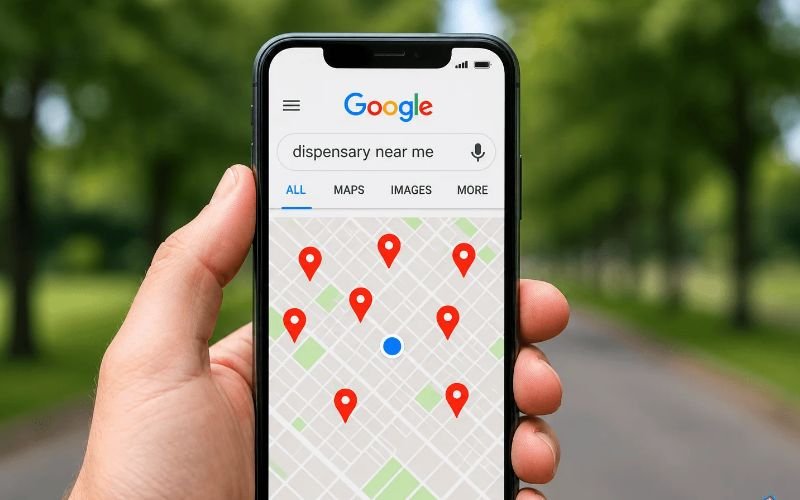
Distance is particularly important for “near me” searches.
Google considers the distance between the searcher and the businesses that may match the query. If the searcher’s location is unavailable, Google may use other location information to estimate where the search is coming from.
This creates a practical challenge for dispensaries.
A store may appear prominently when someone searches from a nearby neighborhood but appear lower when the same person searches from another part of the city.
For this reason, a single ranking check does not tell you how visible your dispensary is across its entire market.
Prominence: How Established Is Your Business Online?
Prominence refers to how well-known a business is.
Google explains that prominence can be informed by factors such as links from other websites and customer reviews.
For a dispensary, this makes local reputation and credible online references worth developing.
Relevant opportunities include:
- Genuine customer reviews
- Accurate business listings
- Relevant local media coverage
- Mentions from legitimate industry publications
- Links from relevant local organizations and websites
- Useful content on the business website
These activities can strengthen your online presence, but none guarantees a particular local ranking.
The practical takeaway: Improve relevance through accurate business information, understand distance limitations, and build prominence through genuine reputation and relevant online references.
3. Audit Your Current “Dispensary Near Me” Visibility
Before changing your website or business listings, establish where your dispensary currently appears.
Without a baseline, it is difficult to know whether an SEO campaign is improving visibility or simply changing website content.
Start by checking three areas.
Check Google Maps Visibility
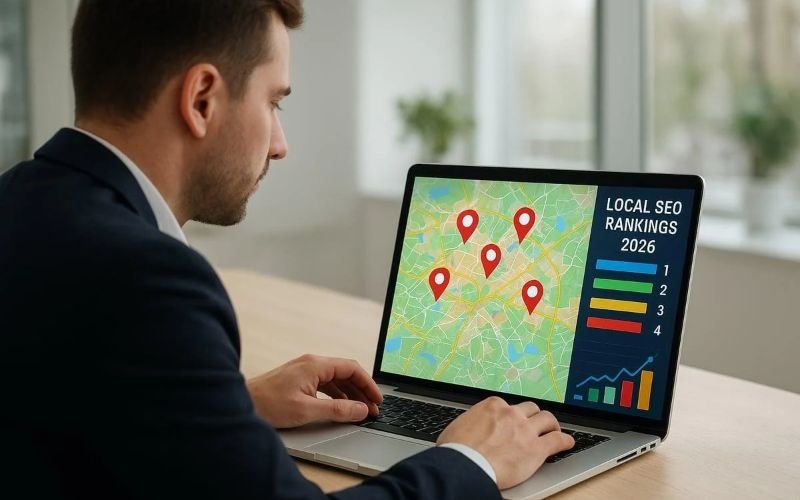
Search for relevant terms from different locations around your store.
For example, a dispensary in Los Angeles could review searches from:
- The neighborhood around its physical store
- Nearby commercial areas
- Adjacent neighborhoods
- Other parts of its genuine trading area
Do not rely on one search from the store address. Results may vary depending on the searcher’s location.
Check Traditional Organic Results
Google Maps visibility and traditional website rankings are different things.
A dispensary may have a business listing that appears in Maps but a website that does not rank well in organic search. Another business may have a strong organic location page but limited visibility in Maps.
Review both separately.
Record Your Starting Position
Create a simple baseline report containing:
| Measurement | What to record |
| Google Maps visibility | Position across selected geographic points |
| Organic rankings | Position of the location page for relevant searches |
| Google Search Console | Impressions, clicks, and search queries |
| Business profile performance | Available calls, website clicks, and direction-related interactions |
| Website conversions | Relevant enquiries or other measurable customer actions |
| Competitor visibility | Businesses appearing consistently in target areas |
This report will help you identify whether the main problem is local relevance, website visibility, competition, or conversion performance.
4. Set Up an Accurate and Eligible Google Business Profile
A Google Business Profile can help eligible businesses appear in Google Search and Maps.
For dispensaries, profile eligibility and Google’s policies require particular attention. Do not assume that every cannabis-related business model qualifies.
If your business is eligible, make sure the information accurately represents the real-world store.
Use Your Actual Business Name
Your profile name should match the name customers recognize on your storefront and across your business materials.
Do not add extra keywords such as:
- Best Dispensary in Los Angeles
- Cannabis Dispensary Near Me
- Cheap Marijuana Store
unless those words are genuinely part of the business’s real-world name.
Adding search terms to a business name simply to influence rankings can create policy problems.
Use the Correct Physical Address
The listed address should represent the actual business location.
Avoid using:
- Virtual offices
- Unstaffed coworking addresses
- Mailboxes
- Locations where the business does not operate
Google’s guidelines specifically state that businesses associated with age-restricted products such as cannabis need a storefront to qualify as service-area businesses.
Check the current eligibility requirements before creating or changing a profile.
Choose an Appropriate Business Category
Select the most specific category available that accurately describes the business.
Do not add unrelated categories to target more keywords. Google recommends using as few categories as necessary to describe the business’s overall core activity.
Keep Business Information Updated
Review these details regularly:
- Business name
- Physical address
- Opening hours
- Website URL
- Contact information
- Business category
- Holiday or temporary hours, where applicable
Accurate hours are particularly relevant to people searching for a dispensary that is open.
Write a Useful Business Description
The description should explain what the business is and provide relevant information to customers.
Keep it factual and natural. Avoid keyword stuffing, unsupported claims, excessive promotional language, and links.
Google’s official Business Profile guidelines explain the requirements for business names, descriptions, addresses, and categories.
5. Build a Location Page That Supports “Dispensary Near Me” Searches
Your website should make it easy for both search engines and visitors to understand where your dispensary operates.
A dedicated location page can support that goal, particularly when the business has a physical storefront.
For a single-location dispensary, the homepage may already serve this purpose if it clearly communicates the business’s location and identity. A separate location page should only be created when it provides additional value.
For businesses with multiple genuine storefronts, each location can have its own useful page.
What Should a Dispensary Location Page Include?
A useful location page should answer the questions a potential visitor is likely to have.
Include:
1. Clear location information
Show the real business name, physical address, and relevant local area.
2. Accurate opening hours
Keep the hours consistent with the information maintained on eligible business listings.
3. Store details
Explain what type of retail business operates at the location and provide useful, accurate information about the store.
4. Directions and accessibility information
Help visitors understand where the store is located and how to find it. A map or directions section can be useful where appropriate.
5. Original location-specific content
Explain details that genuinely distinguish this store from other locations. Avoid copying the same paragraph and changing only the city name.
6. Clear navigation
Visitors should be able to find the location information, contact details, and other relevant website sections without difficulty.
Example of a Location Page Structure
For a dispensary in Los Angeles, the page could follow this structure:
- H1: Cannabis Dispensary in Los Angeles
- H2: About Our Los Angeles Store
- H2: Store Location and Opening Hours
- H2: What to Know Before Visiting
- H2: Frequently Asked Questions
The page should use the city naturally. It does not need to repeat “dispensary near me” in every heading.
Avoid Creating Unnecessary City Pages
Creating dozens of pages for nearby cities without genuine business locations or useful local information is not a sustainable strategy.
A page targeting a city should have a clear purpose and provide information that is genuinely relevant to that location.
The objective is to help visitors understand the actual business—not create a collection of nearly identical pages for search engines.
6. Strengthen Local Relevance and Business Prominence
Once your website and business information are accurate, work on developing a stronger online reputation.
This requires more than submitting your business to hundreds of directories.
Focus on relevant platforms, genuine customer feedback, and credible local references.
Build Accurate Business Listings
Check whether your dispensary’s business information is accurate across relevant platforms.
Depending on availability and eligibility, these may include:
- Apple Business Connect
- Bing Places
- Yelp
- Relevant cannabis industry directories
- Local business directories
- Legitimate industry association listings
Use the same real-world business name, address, website, and contact details wherever applicable.
Correct outdated listings rather than creating unnecessary duplicates.
Develop a Genuine Review Process
Customer reviews can help people evaluate a business before visiting.
Create a simple process for inviting genuine feedback from customers, subject to applicable platform policies and local regulations.
For example:
- Make it easy for customers to find the business’s review page.
- Invite honest feedback without requiring a positive rating.
- Do not purchase reviews or offer incentives in exchange for positive ratings.
- Respond professionally to feedback.
- Use recurring complaints to identify areas where the business can improve.
A review strategy should focus on authentic customer experiences. Avoid making guarantees about how many reviews are needed to reach the top of Google Maps.
Earn Relevant Local Mentions and Backlinks
A relevant mention from a legitimate local publication or industry website can help establish your business’s online presence.
Consider opportunities such as:
- Local business features
- Relevant cannabis industry publications
- Community organizations
- Genuine business partnerships
- Industry interviews
- Local events where participation is permitted
The quality and relevance of a reference matter more than simply collecting a large number of links.
Avoid automated backlink packages, irrelevant guest-post networks, and paid link schemes designed to manipulate rankings.
7. Improve Website Quality and Technical SEO
A well-optimized business profile cannot compensate for a website that is difficult to access, understand, or use.
Your website should provide a reliable experience, particularly for visitors using mobile devices.
Check Mobile Usability
Review the website on different mobile screen sizes.
Pay attention to:
- Readable text
- Clear navigation
- Working buttons and links
- Accessible location information
- Properly displayed images
- A usable contact or enquiry process
A visitor who cannot find the address or understand the store’s opening hours may leave without taking action.
Review Page Speed and Core Web Vitals
Use Google PageSpeed Insights to identify performance issues.
Pay attention to:
- Largest Contentful Paint (LCP)
- Interaction to Next Paint (INP)
- Cumulative Layout Shift (CLS)
Improve oversized images, unnecessary scripts, excessive third-party tools, and other issues identified during testing.
Do not treat a perfect PageSpeed score as a ranking guarantee. The purpose is to make the website faster and more usable.
Check Indexing and Crawlability
Your location page should be accessible to search engines.
Review:
- Whether the page returns a successful HTTP response
- Whether it is blocked by robots.txt
- Whether it has an accidental noindex directive
- Whether the canonical points to the intended URL
- Whether important internal links lead to the page
- Whether the page is included in the XML sitemap where appropriate
Use Google Search Console’s URL Inspection tool to check how Google sees the page.
Add Appropriate Structured Data
Structured data can help search engines understand information about a business.
For a genuine physical business location, a suitable LocalBusiness subtype may be appropriate if it accurately describes the business and the implementation follows Google’s guidelines.
Useful information can include:
- Business name
- Physical address
- Website URL
- Telephone number
- Geographic coordinates
- Opening hours
Only mark up information that is accurate and visible or otherwise properly represented on the page.
Structured data does not guarantee a rich result or improved ranking. Follow Google’s documentation and test the implementation before publishing:
8. Track Local Rankings Across Your Actual Trading Area
A dispensary should not measure local SEO success using one ranking position.
Because distance affects local results, visibility can differ from one neighborhood to another.
Use a local rank-tracking grid or another consistent location-based measurement method to understand how your business appears across the areas that matter.
What Should You Track?
Google Maps visibility: Monitor how often your business appears for relevant searches across selected geographic points.
Organic keyword rankings: Track your location page and relevant website pages separately from Maps results.
Search Console performance: Review impressions, clicks, average positions, and the queries bringing visitors to your website.
Business profile interactions: Where available, review website clicks, calls, and direction-related interactions.
Website conversions: Measure meaningful actions, not just visits. These might include qualified enquiries or other actions the business can legitimately track.
Review the Data Before Changing Your Strategy
Suppose a dispensary performs well around its storefront but appears less frequently in a distant neighborhood.
That does not automatically mean its website needs more keywords. Distance may be a major limitation.
On the other hand, if the dispensary is not appearing for relevant searches even near its physical location, review its business information, website relevance, profile eligibility, technical health, and local prominence.
The right improvement depends on the problem identified in the data.
9. Common Mistakes That Can Hurt Dispensary Local SEO
Some optimization tactics create more problems than they solve.
Avoid these common mistakes:
Keyword stuffing in the business name: Adding terms such as “dispensary near me” to a profile name when they are not part of the real business name can violate Google’s guidelines.
Fake business locations: Do not create profiles for virtual offices, unstaffed addresses, or locations where the business does not operate.
Duplicate location pages: Multiple pages with nearly identical content do not create genuine local relevance.
Copied city content: Replacing one city name with another is not a substitute for useful location-specific information.
Buying customer reviews: Paid or manipulated reviews can damage credibility and violate platform policies.
Low-quality backlinks: Irrelevant links and link schemes are not a reliable way to build prominence.
Ignoring distance: A dispensary cannot assume it will rank first across an entire city simply because its website is optimized.
Measuring only one keyword: A useful local SEO report should consider Maps visibility, organic rankings, customer actions, and performance across different areas.
10. Important Cannabis Marketing Considerations in the USA and Canada
Cannabis businesses operate in a regulated industry. Local SEO should be planned with the relevant laws and platform policies in mind.
In the United States, cannabis rules vary by state and locality. A business should review the requirements that apply to its licence, storefront, website, advertising, and marketing activities.
Google also maintains separate requirements for Business Profiles, including restrictions concerning storefront eligibility for businesses associated with age-restricted products.
Before publishing promotional content, changing a business listing, or launching a campaign, have the relevant material reviewed against the applicable rules.
SEO does not remove the need to comply with cannabis marketing regulations.
11. Frequently Asked Questions
How can I rank my dispensary for “dispensary near me”?
Start by checking local visibility around your physical store. Make sure your business information is accurate, your eligible Google Business Profile follows Google’s guidelines, and your website clearly explains the store’s location. Build genuine customer reputation and relevant local references, then monitor Maps and organic results separately.
Can a dispensary rank number one on Google Maps?
A dispensary may achieve strong visibility in some local searches, but no business can guarantee the number-one position for every searcher. Google’s local results consider relevance, distance, and prominence, so rankings can vary by search location.
Does Google Business Profile help dispensaries rank locally?
An eligible and accurately maintained Google Business Profile can help Google understand a business and display its information in local results. Eligibility and policy requirements must be checked carefully, particularly for cannabis businesses.
Why does my dispensary rank in one neighborhood but not another?
Distance is one of Google’s main local ranking factors. A dispensary may be more relevant geographically to someone searching near its storefront than to someone searching several miles away.
Should I create a separate page for every city near my dispensary?
Only create a city page when it serves a genuine purpose and provides useful, accurate information about the business’s presence or relevance in that location. Avoid creating doorway pages or duplicating content with only city names changed.
Are reviews important for dispensary local SEO?
Reviews can contribute to a business’s online prominence and help potential customers assess its reputation. Encourage genuine, unbiased feedback and respond professionally. Do not buy reviews or promise that a certain review count will produce a specific ranking.
How long does it take to improve dispensary local SEO?
There is no fixed timeline. Progress depends on the starting visibility, competition, location, website condition, business profile eligibility, and the work required. Monitor changes over time instead of relying on a guaranteed number of days or months.
Is “dispensary near me” the same as “cannabis dispensary near me”?
Both searches generally indicate local intent, but wording can reflect different preferences or search contexts. A dispensary should focus on clearly describing its real business and location rather than creating separate pages for every close keyword variation.
Final Thoughts
Ranking for “dispensary near me” requires a realistic local SEO strategy not a shortcut or a single profile optimization.
Start with accurate business information and an eligible storefront presence. Build a useful location page, improve the website’s technical quality, earn genuine customer feedback, and develop relevant local authority.
Most importantly, measure visibility across the areas where your customers actually search. A ranking near the storefront, performance in a neighboring area, and organic website visibility are different measurements.
A consistent approach helps dispensary owners understand where they are visible, where competitors are stronger, and which improvements deserve attention next.